Testing a core from the heavy clay soils near Bomen delivers a completely different set of parameters than a sandy profile sampled up on Willans Hill. We see this contrast every week in the lab. Wagga Wagga sits across a landscape where the Murrumbidgee River has laid down metres of alluvium over weathered granite, and a single site can transition from stiff clay to decomposed rock within a metre of depth. A proper soil mechanics study means running the right test sequence on every sample, not applying a generic suite. We log colour, plasticity and moisture condition immediately after opening the Shelby tubes, then assign the index and strength tests that match the stratigraphy. For sites with soft silty layers below the water table at 4 to 6 metres, we often run consolidation and triaxial stages that a standard report would skip. Every result ties back to AS 1726 classification and AS 4678 earthworks thresholds.
A soil mechanics study for Wagga Wagga must separate alluvial plasticity from residual granite behaviour: two materials, one site, completely different design parameters.
Technical details of the service in Wagga Wagga
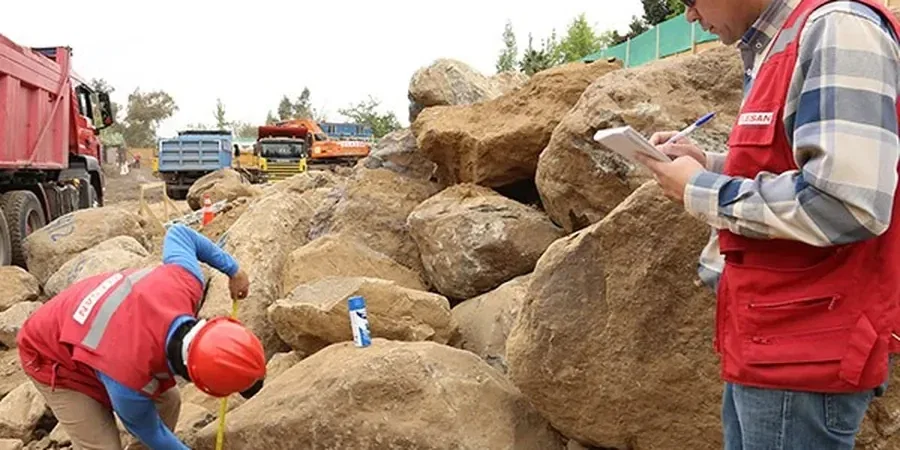
Field demonstration
Critical ground factors in Wagga Wagga
The most frequent mistake we see on Wagga Wagga projects is using a single set of shear strength parameters across a profile that contains both alluvial clay and residual granite. The clay layer dictates stability in winter when the ground is wet, while the granite controls excavation conditions in summer when the upper clay shrinks and cracks. A report that averages these two materials gives a friction angle that is wrong for both. The consequence shows up during bulk earthworks: cut slopes that stand up in dry weather begin slumping after the first sustained rain. With a lab programme that separates each stratum and runs enough specimens to bracket the likely moisture range, the design engineer gets upper-bound and lower-bound values, not an average. On sites within the Wagga Wagga Local Government Area, where the natural drainage lines can concentrate groundwater against a basement wall, we also flag the hydraulic conductivity contrast between the clay and the underlying granitic sand.
Our services
The laboratory programme is built around the ground conditions reported by the driller and the design questions raised by the structural or geotechnical engineer. We group the work into four typical stages.
Index and classification testing
Moisture content, Atterberg limits, particle size distribution by sieve and hydrometer, and linear shrinkage. We classify every sample to AS 1726 before any strength test is scheduled.
Compaction and density control
Standard and modified Proctor curves on bulk samples from the cut. We report MDD and OMC, then run sand cone or nuclear gauge correlations for the site supervisor.
Strength and consolidation
Triaxial compression (CIU, CAU or UU), direct shear and oedometer consolidation. Specimens are trimmed from Shelby tubes or compacted to target density for fill assessment.
Reactivity and durability
Free swell, Emerson class and slake durability for the Wagga Wagga expansive clays. We prepare the report with a site reactivity classification that feeds directly into footing design.
Top questions
How long does a full soil mechanics study take in Wagga Wagga?
Standard classification and compaction tests are reported within five working days of sample receipt. Adding consolidation and triaxial stages extends the schedule to ten to twelve working days because of the time needed for saturation and consolidation phases. We can split the report: classification first, strength parameters later.
What does a soil mechanics study cost for a typical residential site?
For a single-dwelling block with a standard suite covering Atterberg limits, particle size distribution, Proctor compaction and a reactivity classification, the fee ranges from AU$5.070 to AU$8.230 depending on the number of samples and whether triaxial or consolidation stages are included.
Which AS 1289 methods do you use for the Wagga Wagga expansive clays?
We run AS 1289.3.1.1 for liquid limit, 3.2.1 for plastic limit, 3.4.1 for linear shrinkage and 3.8.2 for free swell. For Emerson class we follow AS 1289.3.8.1. The combination gives a reliable site reactivity classification for the red-brown and grey clays common across the region.