Wagga Wagga sits on the Murrumbidgee River floodplain, where deep alluvial deposits alternate with weathered granite. Summer pavement temperatures here regularly exceed 60°C at the surface while the subgrade stays moist from winter flooding. That thermal gradient plus the expansive clay fraction in the Wagga Wagga soil profile creates longitudinal cracking in poorly designed pavements. The Austroads mechanistic-empirical method works, but only when the resilient modulus is calibrated to local CBR values. We run laboratory soaked CBR on Shelby tube samples retrieved from the actual alignment, not borrowed from a database. For roads crossing the heavier basalt-derived clays north of the city, we also correlate results with grain-size distribution and Atterberg limits to capture the full shrink-swell potential.
A Wagga Wagga pavement lives or dies by the soaked CBR at formation level—everything else is just arithmetic.
Technical details of the service in Wagga Wagga
Our approach follows the Austroads Guide to Pavement Technology Part 2, with all testing performed in an ISO 17025-accredited laboratory. We model the pavement structure using CIRCLY, running multiple load cases to envelope the actual truck traffic spectrum. The output is a thickness design that accounts for the high diurnal temperature range specific to the Riverina.
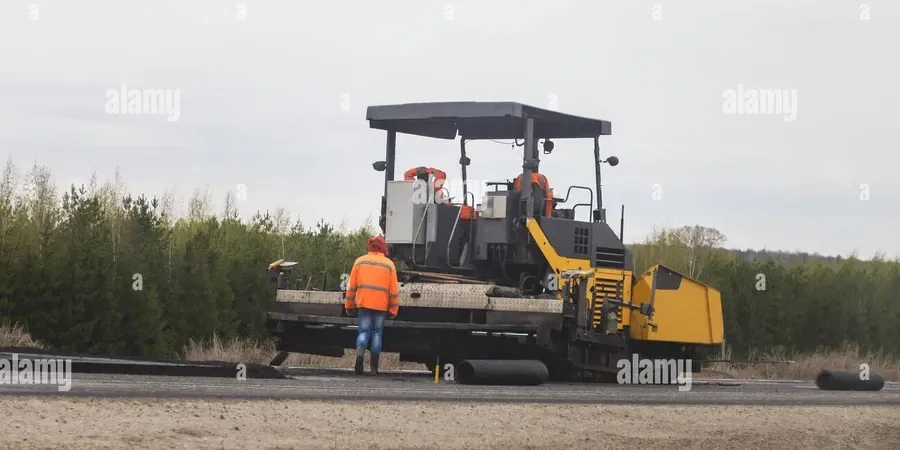
Critical ground factors in Wagga Wagga
We use a heavy pavement coring rig with a 150 mm diamond barrel to extract full-depth cores from existing pavements before rehabilitation design. In Wagga Wagga, where the water table can rise within 1.2 m of the surface after spring rains, the recovered core often tells a story of moisture damage at the base course interface. The rig drills through asphalt, granular layers, and into the subgrade, capturing the bond condition between each lift. We log the core immediately on site, photograph it, and measure the remaining asphalt thickness with a vernier caliper. Those measurements feed directly into the falling weight deflectometer back-calculation model. If the core shows stripping of bitumen from aggregate or softening of the subgrade, we recommend a subsurface drainage intervention before placing any new overlay.
Delaying a proper investigation means the next overlay fails prematurely. The cost of coring and FWD testing is negligible compared to reconstructing a failed pavement section under traffic control on the Sturt Highway.
Our services
We offer the full pavement investigation and design sequence tailored to Riverina conditions.
Subgrade investigation and CBR testing
Borehole drilling, Shelby tube sampling, and soaked CBR determination per AS 1289.6.1.1. We map the subgrade strength variability along the entire alignment.
Pavement structural design
Mechanistic analysis using CIRCLY or APSDS with traffic load spectra derived from actual classification counts. We optimize layer thicknesses for the design ESA.
FWD and coring for rehabilitation
Deflection testing with a JILS-20 FWD and 150 mm diameter coring. Back-calculation of layer moduli and residual life assessment using Austroads methodology.
Top questions
What determines the thickness of a flexible pavement in Wagga Wagga?
The soaked CBR of the subgrade is the starting point. The Austroads design procedure then determines the granular and asphalt thickness required to protect the subgrade from rutting and fatigue cracking for the design traffic loading.
How much does a flexible pavement design and investigation cost for a typical project?
A geotechnical investigation with pavement design typically ranges from AU$2,940 to AU$8,300, depending on the number of boreholes, CBR tests, and the complexity of the traffic analysis required.
Why does the Riverina climate affect pavement performance?
The combination of hot summers, with asphalt surface temperatures over 60 °C, and wet winters that saturate the subgrade creates a severe moisture-thermal cycle. This cycle accelerates oxidation of the binder and reduces subgrade support, so the design must account for both extremes.
Do you use the same design method for residential streets and highways?
No. Residential streets with low traffic volumes are designed using a catalogue-based approach from Austroads, while highways and heavy-duty industrial pavements require full mechanistic analysis with CIRCLY and laboratory-determined material properties.