Wagga Wagga’s road network has expanded steadily since the first Murrumbidgee River crossing was formalised, and with each new subdivision pushing into the former grazing land north of Estella or south of Lake Albert, the need for precise subgrade characterisation grows. The city sits on a mix of alluvial silts and weathered granitic clays that can change stiffness dramatically over a short distance—something we have verified on projects along the Sturt Highway corridor. A laboratory CBR test, run according to AS 1289.6.1.1 with a controlled surcharge and four-day soak, gives us the soaked strength value that RMS and local council engineers require to design the pavement depth. Without that number, you risk either over-excavating good material or placing asphalt on a subgrade that will rut after two wet winters.
A four-day soaked CBR on Riverina clay is not an academic exercise—it is the most reliable predictor of whether your pavement will survive the next flood cycle without expensive patching.
Technical details of the service in Wagga Wagga
Critical ground factors in Wagga Wagga
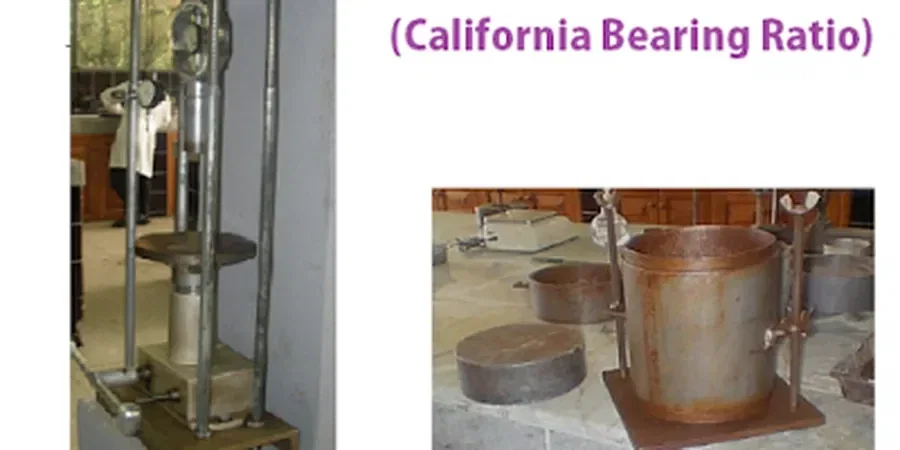
The standard CBR mould is a 152 mm-diameter steel cylinder with a detachable collar and base plate, packed with material compacted at optimum moisture content from a modified Proctor effort. In our Wagga Wagga lab we run the penetration piston at 1 mm/min, reading the load at 2.5 and 5.0 mm against a calibrated proving ring. The most common failure we detect is not outright collapse but gradual strength loss when samples are soaked for 96 hours; many of the red-brown clayey silts from the Glenfield Park area hold up well at placement moisture but drop below 3% CBR after saturation. Local contractors who skip the soaked CBR and rely on field density alone find cracking along the edge line within two years—the pavement base pumps fines upward and the seal debonds. For subdivisions near the floodplain, we often combine the CBR with a site-specific liquefaction screening to check whether the deeper sand lenses could amplify seasonal movement under the formation level.
Our services
Our Wagga Wagga laboratory processes CBR samples within 48 hours of field collection, and we tailor the compactive effort and moisture points to match the earthworks specification. The three service packages below reflect what local contractors and design consultants most often request.
Standard Soaked CBR (Single Point)
One mould compacted at the target moisture and density, soaked for four days under a 4.5 kg surcharge, then penetrated. Includes moisture content before and after soak plus a brief interpretive note on the CBR value relative to typical RMS subgrade categories.
Three-Point CBR with Moisture-Density Relationship
Three moulds compacted at different moisture contents spanning optimum, each soaked and tested. Paired with a full modified Proctor curve, this package lets the pavement designer select the design CBR for a realistic field moisture range rather than a single idealised point.
CBR with Preliminary Lime Demand
For plastic subgrades where stabilisation is under consideration, we run the soaked CBR series alongside an Eades and Grim pH test to estimate the lime addition rate. This package gives the geotechnical engineer enough data to decide between a deeper granular layer and a chemically stabilised working platform.
Top questions
What is the typical turnaround time for a laboratory CBR test in Wagga Wagga?
We schedule sample preparation and compaction on the day of collection, and the four-day soak begins immediately. Penetration testing and reporting follow on the fifth working day, so most single-point CBR reports are issued within five to six working days. Three-point packages take roughly eight working days because of the extra compaction and curing steps.
How much does a laboratory CBR test cost for a local road project?
A single-point soaked CBR test in our Wagga Wagga laboratory typically ranges from AU$220 to AU$360, depending on whether the sample is remoulded at one moisture point or requires a full moisture-density curve alongside it. The three-point package, which includes the Proctor relationship, sits at the upper end of that range because of the additional moulds and technician time.
Can the CBR test be performed on material with gravel larger than 19 mm?
AS 1289.6.1.1 requires material passing the 19 mm sieve. If the field sample contains oversize gravel, we sieve it out and report the percentage removed; for gravel contents above 20%, the CBR result becomes indicative rather than directly usable for design, and we normally recommend a field CBR trial or a larger-scale laboratory test on the full grading.
Why is a four-day soak necessary for Wagga Wagga clay subgrades?
The Riverina experiences prolonged wet periods, and subgrades near the Murrumbidgee floodplain can remain saturated for weeks. The four-day soak simulates the worst-case moisture condition, which is when the CBR drops to its minimum. Designing pavement thickness on a soaked CBR prevents the rutting and shear failure that appear after several wet seasons.
Do you provide sampling guidance for CBR specimens collected in the field?
Yes—our technicians supply sealed plastic bags and labelling protocols at the time of collection. We recommend taking at least 25 kg of disturbed material from the top 500 mm of the formation, storing it in a cool place, and delivering it to the lab within 24 hours. If the material is highly plastic and drying out, we can arrange same-day pickup to preserve the natural moisture content.