The soil profiles beneath North Wagga Wagga and the central business district tell two completely different stories. On the northern side of the Murrumbidgee, thick sequences of Quaternary alluvium—loose sands and soft silts deposited by historic flood events—exhibit characteristics that demand careful seismic screening. In contrast, the higher terraces near the city centre often sit on stiffer residual clays derived from weathered granodiorite, where ground shaking amplifies differently. With Wagga Wagga positioned approximately 130 km from the Cadell Fault and subject to moderate intraplate seismicity, the need for rigorous soil liquefaction analysis is not hypothetical. The 2018 amendment to AS 1170.4 refined the seismic hazard map for New South Wales, placing Wagga Wagga in a zone where the hazard factor Z reaches 0.09. We run cyclic stress ratio calculations on undisturbed samples and in-situ test data, comparing the cyclic resistance ratio across each stratum, so that foundation designs in Wagga Wagga are calibrated to the real subsurface rather than generic assumptions. Combining local drilling with advanced laboratory testing, the triaxial cyclic programme gives us the normalised shear stress curves that feed directly into the liquefaction potential index for the site.
A cyclic resistance ratio below 0.15 in saturated Wagga Wagga alluvium transforms a standard foundation into a seismic liability—getting the number right changes the entire structural solution.
Technical details of the service in Wagga Wagga
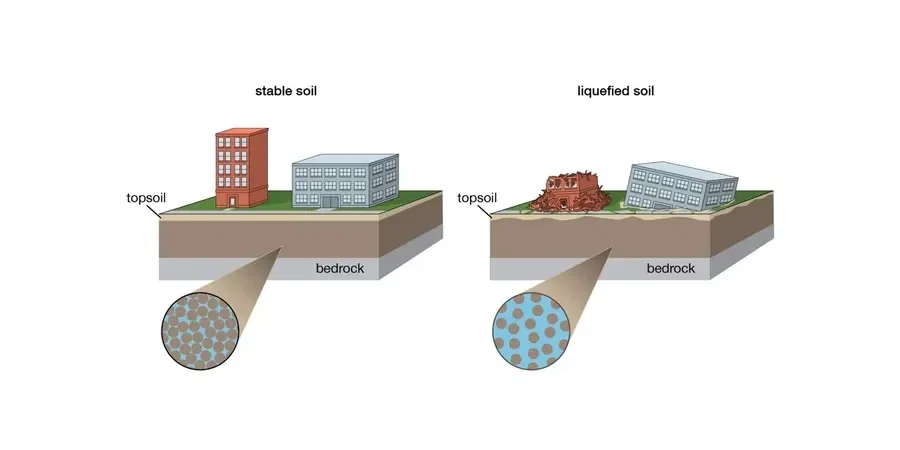
Critical ground factors in Wagga Wagga
The CPT rig we mobilise across Wagga Wagga is a 20-tonne truck-mounted unit with a 200 kN push capacity, equipped with a seismic module that records shear wave velocity every 50 millimetres. When the cone encounters a loose sand unit below 4 metres near the river flats, the friction ratio drops below 0.8% while the pore pressure parameter Bq spikes above 0.4—a classic signature of contractive behaviour. Failing to identify this signature means the structural engineer designs for a static bearing capacity that disappears the moment excess pore pressure develops during shaking. For Wagga Wagga, the combination of moderate seismicity and shallow water table creates a scenario where even a magnitude 5.5 event at 80 km distance can trigger cyclic mobility in untreated ground. The consequence is differential settlement exceeding 100 millimetres across a building footprint, which renders activities inoperable and requires costly underpinning. Our soil liquefaction analysis quantifies this risk explicitly: we deliver settlement maps, lateral spreading displacement estimates using the Newmark sliding block method, and Improvement specifications that target a post-treatment LPI below 2 for ordinary structures and below 0.5 for critical infrastructure.
Our services
Soil liquefaction analysis in Wagga Wagga demands integration of field investigation, laboratory testing, and numerical modelling. Our service covers the full spectrum from screening-level assessment to detailed Improvement design.
CPT-Based Liquefaction Screening
Seismic cone penetration testing across Wagga Wagga sites with continuous pore pressure measurement, providing a high-resolution profile of tip resistance, sleeve friction, and shear wave velocity. We apply the Robertson (2009) soil behaviour type classification and calculate the cyclic resistance ratio using the Boulanger-Idriss (2014) CPT method, delivering a layer-by-layer factor of safety and liquefaction potential index for your design team.
Post-Liquefaction Settlement Analysis
Using SPT and CPT data calibrated to Wagga Wagga alluvial soils, we estimate volumetric strain per stratum following the Ishihara-Yoshimine (1992) procedure. The output is a settlement contour map showing differential movement across the building footprint, allowing structural engineers to specify articulation joints and stiffened raft designs that accommodate predicted ground deformation.
Top questions
What is the typical cost range for a soil liquefaction analysis in Wagga Wagga?
Depending on site access, number of CPT soundings or boreholes required, and the depth of investigation, a complete soil liquefaction analysis for a Wagga Wagga site typically ranges from AU$3,580 to AU$5,860. This includes field data acquisition, cyclic laboratory testing where needed, and the engineering report with CSR/CRR calculations, LPI mapping, and Improvement recommendations.
How does the Murrumbidgee River influence liquefaction risk in Wagga Wagga?
The river controls the shallow groundwater table across much of the floodplain, maintaining saturated conditions within the upper 3 to 4 metres of alluvial sands. Saturated loose sands are precisely the materials most susceptible to pore pressure build-up during cyclic loading. Seasonal fluctuations in river level alter the effective stress profile, so we schedule field investigations to capture the worst-case high-water-table scenario, typically during late winter and early spring in Wagga Wagga.
Which investigation method is more reliable for Wagga Wagga soils: SPT or CPT?
We prefer CPT for liquefaction screening in Wagga Wagga because the continuous profile captures thin sand seams that SPT spoon intervals can miss, and the pore pressure transducer identifies contractive layers directly. However, we typically supplement CPT with at least one SPT borehole to recover samples for fines content and plasticity index determination, since both parameters affect the cyclic resistance correction factors in the Youd-Idriss framework.