In Wagga Wagga, the floodplain geology along the Murrumbidgee River places anchor systems under conditions that demand more than a standard design. The layered profile of Quaternary alluvium — silts over sands and gravels at depth — means bond zone performance varies within a single borehole. The city's growth along the Sturt Highway corridor has pushed retaining structures into areas where the groundwater table sits just a few metres below ground level. A CPT test run before anchor design helps map the exact depth to competent bearing strata, avoiding surprises during installation. Our team treats each anchor as a geotechnical element, not a catalogue item, matching tendon type, corrosion protection class, and grout mix to the specific ground conditions of this inland NSW city.
A properly designed anchor loads the ground behind the failure plane — everything else is just a steel bar in a hole.
Technical details of the service in Wagga Wagga
- Ultimate bond stress in the Murrumbidgee gravels versus the overlying clayey silts
- Free-length calculation through the active wedge, per AS 4678 Appendix C
- Lock-off load to allow for relaxation losses in the tendon
- Proof testing protocol to 125% of design load, with creep monitoring over a minimum 15-minute hold
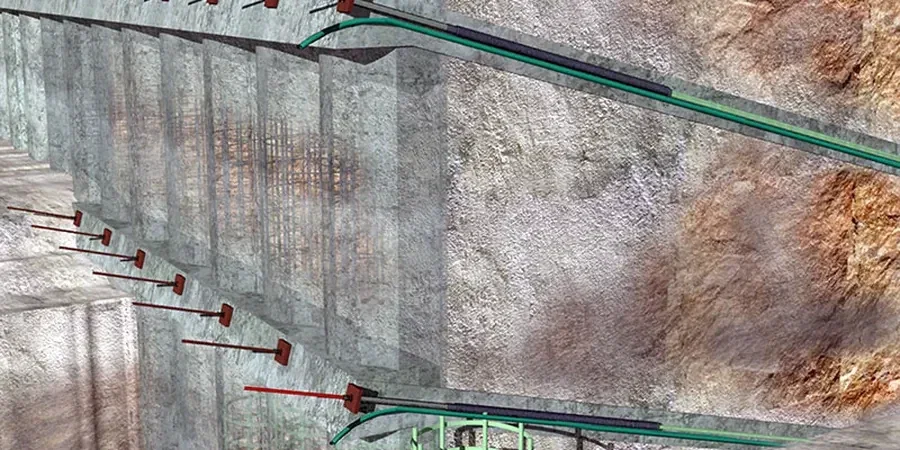
Field demonstration
Critical ground factors in Wagga Wagga
Wagga Wagga's expansion onto lower-lying ground south of the CBD has multiplied the number of excavations that need tieback support. The city's population of roughly 70,000 has grown steadily, pushing residential and commercial development into areas underlain by soft alluvial clays. The geotechnical risk is not theoretical: a passive anchor that is too short places the load outside the stable zone, and the wall moves. An active anchor inadequately protected against corrosion in the Murrumbidgee's fluctuating water table will lose section over time, silently. The risk compounds in cohesive soils where time-dependent creep can relax anchor load by 10-15% within the first few months after tensioning. Our design approach explicitly models the long-term creep behaviour using parameters from site-specific laboratory testing, not textbook values, because the Riverina clay responds differently than the shale-derived soils of Sydney or Melbourne.
Our services
Our anchor design work in Wagga Wagga covers the full workflow, from feasibility through to construction support and testing supervision.
Active anchor design
Tendon sizing, free-length geometry, bond-length calculation, and lock-off specification for stressed anchors that control wall deflection.
Passive anchor design
Design of untensioned reinforcement elements — soil nails or passive tiebacks — that mobilise resistance through ground deformation.
Corrosion protection specification
Selection of Class I or II protection systems per AS 4678, considering Wagga Wagga soil aggressivity and groundwater chemistry.
Proof testing and construction support
On-site supervision of anchor installation, grout QA, and acceptance testing with creep monitoring to confirm design assumptions.
Top questions
What is the difference between an active and a passive anchor?
An active anchor is stressed after installation to apply a pre-determined load against the retaining structure, controlling movement from day one. A passive anchor is not tensioned; it only develops resistance as the ground deforms and loads the tendon. Active anchors suit walls where adjacent structures cannot tolerate displacement. Passive anchors work well in cut slopes or temporary excavations where some movement is acceptable. The choice depends on the allowable deformation and the stiffness of the retained soil profile.
How does the Murrumbidgee River alluvium affect anchor bond length?
The alluvial sequence beneath Wagga Wagga typically comprises silty clays overlying sands and gravels at variable depth. Bond stress in the clay is low — often 30-60 kPa — while the underlying gravels can sustain 200-400 kPa or more. The anchor must extend through the clay into competent gravel to achieve the required capacity. CPT soundings are essential to locate the top of the gravel layer precisely; guessing the depth adds unnecessary metreage to every anchor.
What does anchor design and installation cost in the Wagga Wagga area?
For design, proof testing supervision, and construction-phase support, budgets in the Wagga Wagga area typically range from AU$1,660 to AU$5,250 depending on the number of anchors, the complexity of the ground profile, and whether the anchors are permanent or temporary. This covers the geotechnical design package — tendon specification, bond calculations, corrosion protection details, and testing criteria — but excludes the physical anchor supply and installation, which varies widely with depth and access.
What proof testing is required for permanent anchors?
AS 4678 requires acceptance testing on a minimum of one anchor per row, or 5% of total anchors, whichever is greater. Each anchor is loaded to 125% of the design load and held for at least 15 minutes while creep is monitored. The creep rate must stabilise; if it does not, the anchor may be under-designed or the bond zone compromised. In Wagga Wagga's cohesive soils, we extend the hold period to 30 minutes on the first few anchors to capture time-dependent behaviour early in the programme.