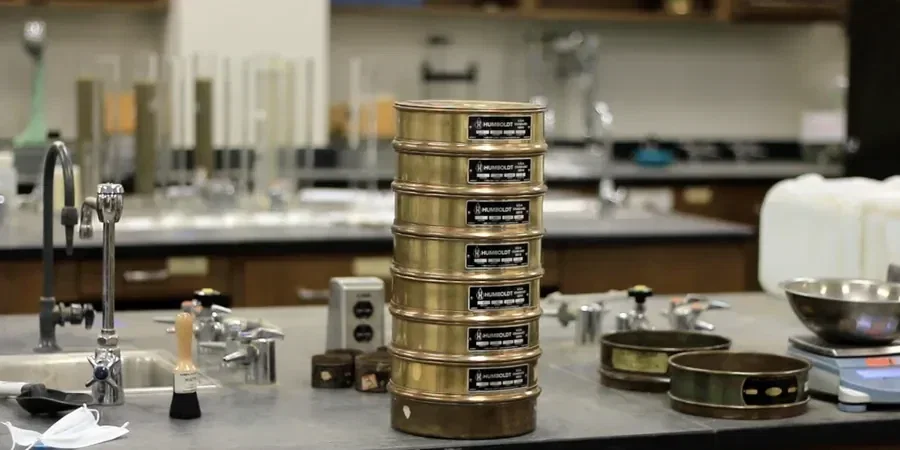
A full set of brass sieves stacked on the Ro-Tap shaker is what we unpack first on any Wagga Wagga job. The machine runs for about ten minutes per sample, shaking the stack mechanically while our technician preps the hydrometer cylinder for the fines fraction. Wagga Wagga sits on the Murrumbidgee River floodplain, so the soils here shift dramatically from clean sands near the river to silty clays just a few hundred metres south of the CBD. Getting the full particle size distribution matters because a poorly graded sand and a gap-graded silty sand behave completely differently under load. We run the analysis in our lab accredited to ISO 17025, following AS 1726 for site investigation practice, and combine it with Atterberg limits when the fines content exceeds 12 percent to characterise plasticity properly.
A visual estimate of a soil's gradation is wrong more often than it is right. The sieve and hydrometer curve removes that uncertainty completely.
Technical details of the service in Wagga Wagga
Critical ground factors in Wagga Wagga
In the Wagga Wagga area, we frequently encounter alluvial lenses of silty sand that look competent in a test pit wall but liquefy quickly if water enters the excavation. Without a grain size curve showing the fines content and the D10 size, a contractor cannot design a dewatering system that actually works. The grain size distribution also controls the internal stability of filter blankets used behind retaining walls along the Murrumbidgee levees. A gap-graded material can erode internally, washing fines out through the coarser matrix until the structure collapses. That failure mode is entirely preventable if the grading curve is checked against the Terzaghi filter criteria during design. We flag these risks early because waiting until the excavation fills with water is the expensive way to discover a gradation problem.
Our services
Our grain size analysis service in Wagga Wagga covers the full workflow from field sampling to final curve delivery. Each of these steps follows our ISO 17025 quality system.
Field sampling and transport
We collect disturbed bulk samples from test pits, auger holes, or stockpiles across Wagga Wagga, logged to AS 1726 and sealed in heavy-duty bags for chain-of-custody transport to the lab.
Mechanical sieve analysis
Coarse and sand fractions are dry-sieved through AS 1289 sieve stacks. We report percent retained on each sieve and calculate the full gradation curve including D10, D30, and D60.
Hydrometer sedimentation
The minus 75-micron fraction is analysed by hydrometer in a temperature-controlled cylinder. Readings are taken at 0.5, 1, 2, 4, 8, 15, 30, 60, 120, and 1440 minutes.
Combined curve and classification
We merge the sieve and hydrometer data into a single semi-log plot, classify the soil per the Unified Soil Classification System, and deliver the curve in PDF and CSV formats.
Top questions
How much does a grain size analysis cost in Wagga Wagga?
A combined sieve and hydrometer analysis typically ranges from AU$160 to AU$310 per sample, depending on the number of sieve sizes requested and whether the hydrometer curve is required. Bulk pricing applies for more than five samples from the same site.
How long does the hydrometer test take from start to finish?
The hydrometer sedimentation test requires a minimum of 24 hours because the final reading at 1440 minutes is needed to capture the clay fraction. We usually report the combined sieve and hydrometer curve within three working days of receiving the sample.
Do I need the hydrometer analysis if my material looks sandy?
If the sample contains more than about 10 percent fines passing the 75-micron sieve, the hydrometer analysis is strongly recommended. The fines fraction controls permeability, shrink-swell potential, and frost susceptibility, none of which can be assessed from the sieve curve alone.
What sample size do you need for a reliable grain size analysis?
For materials with gravel and cobbles we need at least 5 kg of representative material. For sands and silty sands, about 500 grams is sufficient. We can advise on minimum sample mass once we know the maximum particle size expected at your Wagga Wagga site.