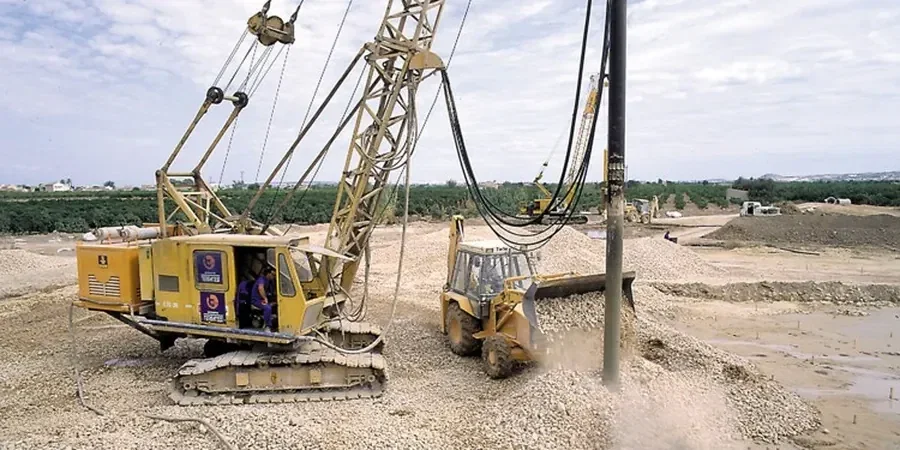
The vibroflot rig arrives on a flatbed truck, its long lance and bottom-feed hopper already assembled after the drive from the depot. In Wagga Wagga, where the Murrumbidgee River has laid down metres of soft silty clay across the floodplain, that rig becomes the most practical tool for improving ground without a massive over-excavation. We set up on sites from Bomen to Estella and feed stone through the bottom of the vibrating probe, forcing aggregate outward in compacted lifts. The result is a stiff column of well-graded crushed rock that replaces a portion of the compressible soil, shortening drainage paths and boosting bearing capacity. For warehouse slabs near the Bomen industrial precinct or approach embankments on the Olympic Highway, this method lets the project stay on grade without importing structural fill. Before committing to the column grid, we typically confirm the undrained shear strength profile with CPT testing to ensure the surrounding clay can offer adequate lateral confinement during column installation.
A well-designed stone column grid in Wagga Wagga's alluvial clays can cut settlement time from years to weeks, purely by shortening the drainage path to less than a metre.
Technical details of the service in Wagga Wagga
Critical ground factors in Wagga Wagga
The older parts of Wagga Wagga grew along the Murrumbidgee without the deep foundations we expect today. Many heritage buildings near Fitzmaurice Street sit on shallow footings that have performed adequately for decades, but that history creates a false sense of security when new development pushes onto the softer floodplain pockets. What we see most often is differential settlement between the treated and untreated portions of a slab, particularly where a stone column grid stops at a property boundary and the neighbouring structure remains on unimproved ground. The transition zone needs careful detailing. Another risk is column bulging in very soft clay with undrained shear strength below 15 kPa; here the lateral confinement is insufficient unless the area replacement ratio is increased above 30% or the design is switched to a rigid inclusion system. Poorly controlled installation can also generate excess pore pressures that temporarily reduce soil strength, so we require piezometer monitoring on sensitive sites and a defined waiting period before load testing. The team works to AS 4678 throughout, and our laboratory operates under NATA accreditation to ISO/IEC 17025 for the supporting soil classification and strength tests.
Our services
Our stone column work in Wagga Wagga covers the full sequence from field investigation through to post-installation verification. Each phase is calibrated to the Murrumbidgee floodplain conditions.
Design development and settlement analysis
We prepare column grid layouts, area replacement ratios, and load transfer platform details using Priebe’s method and 2D/3D finite element analysis calibrated to site-specific CPT and laboratory consolidation data.
Installation supervision and quality control
Full-time supervision during wet-feed or bottom-feed vibro-replacement, including recording depth, amperage, and stone consumption per column, plus post-installation modulus verification with plate load tests.
Integrated Improvement for embankments
For road approaches and levee upgrades near the Murrumbidgee, we combine stone columns with staged construction and basal geogrid reinforcement to manage both settlement and slope stability under AS 4678.
Top questions
What does stone column design cost for a typical Wagga Wagga industrial site?
For a standard warehouse pad on soft clay in the Wagga area, the combined design, site investigation, and installation supervision typically falls between AU$2,120 and AU$8,570, depending on the treated area, column depth, and the number of verification tests required.
Can stone columns be used when the water table is very high, like near the Murrumbidgee River?
Yes. The vibratory method works below the water table, and the columns actually accelerate consolidation by providing radial drainage. In Wagga Wagga we often design them specifically for high groundwater conditions, specifying a clean crushed aggregate that resists clogging and maintains permeability over the design life.
How do you verify that the stone columns have been installed correctly?
We use a combination of real-time installation records (depth, amperage, stone volume per lift) and post-installation testing. On Wagga Wagga projects this typically includes plate load tests on individual columns and, for larger sites, multi-level settlement plates or CPT soundings through the column centre to confirm the achieved stiffness profile.