The Riverina's expansive clay soils respond dramatically to moisture changes. Wagga Wagga sits on layered alluvial deposits from the Murrumbidgee River, where dry spells crack the surface and seasonal rains trigger swelling that shifts shallow footings. A standard penetration test gives you blow counts, but a triaxial test replicates the actual stress state deep in the ground. We run consolidated-undrained and drained stages to isolate effective stress parameters. That matters when you are designing basements near the floodplain or anchoring retaining structures along Kooringal Road. For pavement subgrades on the Olympic Highway corridor, pairing triaxial data with CBR testing ensures the pavement thickness accounts for both strength and moisture sensitivity.
A single triaxial curve reveals more about Wagga Wagga clay behaviour than a dozen SPT numbers.
Technical details of the service in Wagga Wagga
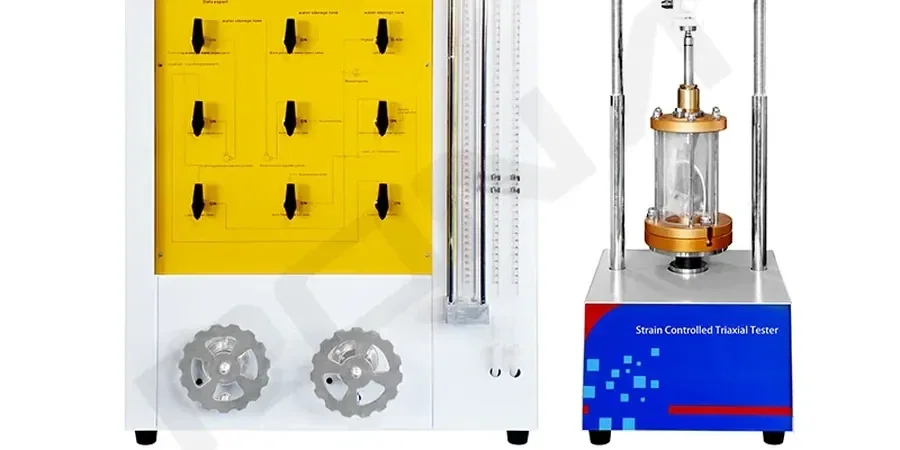
Critical ground factors in Wagga Wagga
Wagga Wagga sites near the river often contain interbedded silt lenses that drain faster than the surrounding clay. A triaxial test run too quickly on these soils produces misleading excess pore pressures. Our team adjusts strain rates based on consolidation history: slower rates for low-permeability clays, faster for silty seams. Another local observation: samples from the Kooringal area sometimes contain residual cementation from ancient calcareous nodules. That cementation breaks down during saturation if back pressure is applied too aggressively, yielding artificially low cohesion. We see this pattern often enough that we now run paired tests, one with gentle saturation and one with standard procedure, to bracket the true strength envelope for foundation design on the sloping terrain east of the CBD.
Our services
Our Wagga Wagga triaxial testing program covers the full range of shear strength determination for local ground conditions.
Consolidated-Undrained (CU) with pore pressure
Effective stress parameters for short-term stability analysis of riverbank cuts and excavation slopes across the Murrumbidgee floodplain.
Consolidated-Drained (CD) testing
Drained friction angle and cohesion for long-term design of retaining walls and bridge abutments in the Wagga Wagga area.
Unconsolidated-Undrained (UU) screening
Quick undrained shear strength values for preliminary footing sizing on low-rise commercial buildings.
Top questions
When does a Wagga Wagga project need a triaxial test instead of just an SPT?
An SPT gives empirical blow counts, but triaxial testing measures effective stress parameters directly. You need it when designing deep basements, analysing slope stability on the city's eastern hills, or working near the Murrumbidgee where pore pressure response controls failure. It is also specified in AS 4678 for retaining wall design where accurate drained strength is critical.
What does triaxial testing cost for a typical site investigation in Wagga Wagga?
A triaxial test program for a local project generally ranges from AU$2,620 to AU$3,620 depending on the number of specimens and whether you need CU, CD, or both. Multi-stage tests on a single specimen reduce the total when sample recovery is limited.
How do you handle sampling in the reactive clays common around Wagga Wagga?
We use thin-walled Shelby tubes pushed at a steady rate to minimise disturbance. Samples are immediately sealed with wax and stored in humidity-controlled boxes. In the lab, extrusion and trimming follow AS 1289 procedures, with extra care during the saturation ramp to preserve natural structure in the highly plastic clays typical of the Riverina.